Saturday, August 16, 2008

Mooooooooon

The moon taken by my lousy camera phone through a Baby-G Takahashi refractor at Astronomy 2008 today (: No processing. Because I don't know how :|

Clear skies,
Anne (:

Friday, August 15, 2008

13 Zodiacal Counstellations

I just now know that there are actually 13 zodiac constellations. Ophiuchus is added in. It is not the latest news, but already dated. But I still want to share with those who do not know it. Modern constellation boundaries were established around 1930, putting part of the ecliptic in Ophiuchus. The astrologers insist on 12 counstellations, because the concept of the astrological zodiac is to divide the ecliptic into twelve equal segments. These signs are named after the constellations they aligned with in the time of Ptolemy, who invented "modern" astrology about 1850 years ago, but really have nothing to do with the constellations. Since Ptolemy, precession of the equinoxes has shifted the alignment by about 25 degrees.

Thursday, August 14, 2008

Interesting question

In Pole to Pole, an early science fiction story by George Gtiffith, three explorers attempt to travel by capsule through a naturally formed tunnel directly from the South Pole to the North Pole. According to the story, as the capsule approaches Earth’s centre, the gravitational force on the explorers becomes alarmingly large and then, exactly at the centre, it suddenly but only momentarily disappears. Then the capsule travels through the second half of the tunnel, to the North pole.
Check Griffith’s description by finding the gravitational force on the capsule of mass m when it reaches a distance r from Earth’s centre. Assume that Earth is a sphere of uniform density p.

This is a question I saw from a physics book. If you work it out, you can find the interesting part.
Hint: use Newtonian Gravitation law. F=G(Mm)/r^2. Remember Newton’s shell theorem: a uniform shell of matter exerts no net gravitational force on a particle located inside it.

I will show the answer SOON! ^.^

Tuesday, August 12, 2008

Announcement

Astro members:
Please take note of this announcement. Pls check your mail for the schedule and the allocation of the group presentation. There is also an attatched file of the EXCO's email address.
!!!Bring $29 dollars in next session for the astro jackets if you have ordered it.

Saturday, August 9, 2008

Event: Astronomy 2008

Hi all! Sorry for the lack of updates recently :P

Anyway! There'll be no astro session next week, so if you're free on Saturday, then do come for Astronomy 2008, an event organised by Singastro forum, at Singapore Art Museum, 10am-5pm 16th August. After that there'll be mass stargazing session outside SMU nearby, so you can stay and join the fun as well!
More details can be found here.

Clear skies,
Anne

P.S. I'm going! So if anyone else is, do tell me, then we can all go together yeah! :D

Monday, July 14, 2008

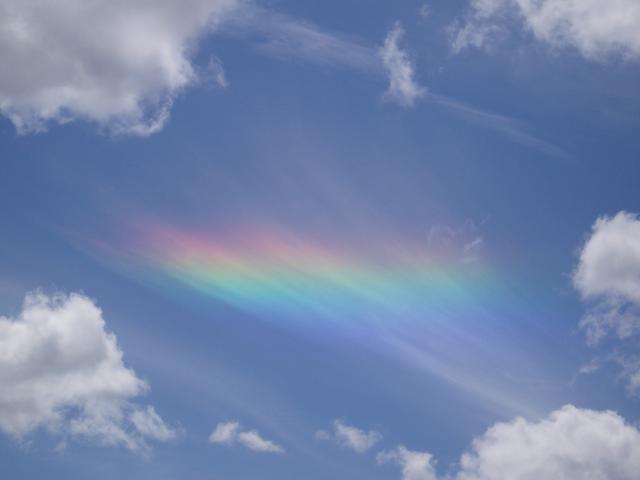
Circumhorizontal arc

Anyone can spot a tiny rainbow among the cirrus cloud?
*hint hint: look above the lamppost!*
If you can't, never mind then, because I think my camera is quite lousy afterall. Anyway, for those who can, what you see is essentially a phenomenon called circumhorizontal arc.

A circumhorizontal arc is created when light is refracted through ice crystals in cirrus clouds. It occurs when the sun is at least 58 degrees above the horizon, and only in presence of cirrus clouds. In contrast to rainbow, circumhorizontal arc is seen on the same side of sky as the sun (so in case you are wondering, the sun in the picture is blocked by the trees).

Below are more pictures of this beautiful phenomenon:
(from http://upload.wikimedia.org/wikipedia/en/2/2d/Circumhorizontal_arc.jpg)
(from http://upload.wikimedia.org/wikipedia/commons/2/22/CircumhorizonArcIdaho.jpg)
(from http://upload.wikimedia.org/wikipedia/en/0/09/Circumhorizon_Arc.jpg)
(from http://upload.wikimedia.org/wikipedia/commons/c/c8/Ohlookarainbow.jpg)
Other related phenomena include iridescent cloud, circumzenithal arc, Kern arc, infralateral arc, supralateral arc, tangent arc, Parry arc, halo, parhelic circle, sundog, etc. in case this is not enough for your knowledge greed :D

I'm still wondering whether this is astro-related. lols

Clear skies,
Anne (:

Saturday, July 12, 2008

Watch "The Sky at Night" online!

Hey all!

This is super interesting! You can access this BBC website to watch current and past episodes of the monthly BBC TV documentary "The Sky at Night" online, hosted by Sir Patrick Moore. The show features a wide range of astronomical topics including stellar life cycles, radio astronomy, black holes, artificial satellites, neutron stars, and current celestial events such as comets or meteor showers, among others.

According to Wikipedia:
"Sir Patrick Moore is a former president of the British Astronomical Association, co-founder and former president of the Society for Popular Astronomy, author of over 70 books on astronomy, presenter of the longest running television series (with the same original presenter), "The Sky at Night" on the BBC and a famous figure on British television (such as being the Gamemaster). He is well known for his rapid mode of speech, trademark monocle, poorly fitting blazers, extremely high trouser line and a fondness for the xylophone."

You can explore other areas of BBC - Science & Nature: Space website as well. Do make good use of the resource when you have the time (:

Clear skies,
Anne